Review of The Terminal Man (1972)
Happy 4th of July and 250th birthday, fellow Americans! And everyone, welcome to the July issue of Hacker Chronicles!
I find the founding of the United States of America fascinating in so many ways. The fact that George Washington did not want to become king and instead voluntarily gave up power to Congress after winning the Revolutionary War. How he was elected first President almost six years later. And the time it took for the States to come together and eventually form an effective federal government. Thirteen years!
My family and I visited the National Archives in Washington DC a few years ago. It was profound to see those faded parchments – the Declaration of Independence, the Constitution, and the Bill of Rights. We also went to Philadelphia to be on-site where it all happened.
I bought a book I have yet to read, Why Congress?. It covers the postwar history of the most powerful branch of the US government and argues that the country's future depends on it. I agree.
Here's to the Republic, to a democratic future, and to the rejuvenation of Congress! 🇺🇸🥂
In this issue I review Michael Crichton's sci-fi novel The Terminal Man from 1972.
Enjoy!
/John
Writing Update – Halfway Done!
I'm very happy to have crossed the halfway line on my third novel.
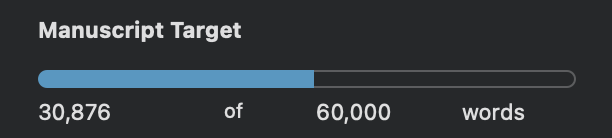
As mentioned before, I might go shorter than 60k words. The story is pretty clear in my mind but I like to let it develop organically beyond the major pieces. I have some traveling coming up and that can go both ways. Either I find time to write a lot, on airplanes and in hotel rooms, or it keeps me busy and I get nowhere in writing.
July Feature: Review of The Terminal Man
Michael Crichton is probably most famous for his novel Jurassic Park but he published a string of sci-fi novels between 1969 and 2006.

Michael Crichton speaking at Harvard 2002.
In the early 1980s, parallel with the budding cyberpunk genre, he published the non-fiction book Electronic Life with advice on how to buy a computer, how to use it, and even how to program it.
In the early 2000s, he was arguably more (in)famous for his novel State of Fear, which is critical of the scientific consensus on climate change.
The Terminal Man was one of his earliest works under his own name.

The cover of The Terminal Man.
It became a movie in 1974.

The movie poster for The Terminal Man.
Hacker Rating
Hacker Realism: ⭐️ ⭐️ ⭐️ ⭐️
Hacker Importance for the Plot: ⭐️ ⭐️
Hacks: ⭐️
Spoiler alert: You know the drill by now. Spoilers ahead.
The Premise
The Terminal Man was published in 1972 and takes place in 1971. The plot revolves around brain implants connected to computers, so it's speculative but not set in the future.
A scientific team in the fictional Neuro-Psychiatric Service, NPS, is developing the surgery and technology necessary to connect computers to human brains and let the computers treat neurological illnesses. They have so far only treated apes, with mixed but encouraging results.
The staff psychiatrist, Janet Ross, questions whether they are ready to treat humans but there is pressure to be the first in the world to do it.
The Patient, Harry
A suitable patient is finally identified – Harry Benson, a computer scientist in his mid-thirties. Harry suffers from seizures during which he turns violent. Afterward he has no memory of what happened and he has beat up several people. He needs some kind of treatment.
Harry worries that computers will take control of humans and is anxious about a computer being connected to his brain. At the same time, he agrees that something drastic needs to be done about his violent seizures.
Thoughts:
The situation for Harry is desperate indeed. The alternative is to confine him to a clinic of some sort. It would be the end of his life as he knows it.
This reminds me of a harrowing story from real life. An old college friend of mine is a professor doing cancer research. He told me how patients who have reached a terminal state sometimes get so desperate that they search for ongoing research and offer to take experimental treatments. Policies and scientific ethics prevent that from happening, but he told me how devastating it is to get those emails. I hesitate to mention it here, that's how bad I feel about it. But it's similar to Crichton's premise underpinning the book. A person gets into a desperate situation and suddenly anything goes.
The Relationship Between Computer and Brain
The head of NPS, Roger McPherson, is already thinking about the next step and the next-next step. For him brain implants are a done deal.
Here is McPherson envisioning the future:
(…) the idea of a brain being like a computer worked two ways, in two different directions. On the one hand, you could utilize the computer to probe the brain, to help you analyze its workings. At the same time, you could use your increased knowledge of the brain to help design better and more efficient computers. As McPherson said, "The brain is as much a model for the computer as the computer is a model for the brain."
Thoughts:
McPherson's point rings especially true in this day and age. The modern AI we refer to as large language models, or LLMs, are fundamentally artificial neural networks.
Scientists identified artificial neural networks as a promising direction for AI in 1955. Soviet researchers Alexey Ivakhnenko and Valentin Lapa published studies of deep neural networks in 1965. Japanese professor Kunihiko Fukushima introduced the ReLU function in 1969 and it is used a lot if you study the fundamentals of LLMs. Fukushima is still alive and 90 years old.
This means that computer science when Crichton wrote The Terminal Man was very much thinking in terms of modeling brain primitives to build thinking computers. But it took until the ChatGPT moment — November 30, 2022 — until it to really happen in a big way.
The Surgery and the Computer
The surgical procedure is described in detail with a lot of suspense. Wired electrodes are embedded in Harry's brain tissue to read and stimulate specific regions of his brain. That way the scientists are able to detect seizures as they develop, and stop them by inducing happy or calm feelings.
Harry carries the computer and it is powered by a long-term plutonium power pack.
Thoughts:
Carrying a personal nuclear power source feels very early 70s. That is something that has not happened. Long-term power in a size you can easily carry is still a dream for what we refer to as personal computing devices but for simpler things they exist.
Post-Operation
McPherson is proud of the first permanent human-computer link. He dictates (shortened from the book):
This procedure represents the first direct link between a human brain and a computer. The link is permanent. Now, a man sitting in a computer console and interacting with the computer by pressing buttons is linked to the computer, but that link is not direct and the link is not permanent. Therefore, this operative procedure represents something rather different. How is one to think about it?
One might think of the computer in this case as a prosthetic device just as a man who has his arm amputated can receive a mechanical equivalent of the lost arm, so a brain-damaged man can receive a mechanical aid to overcome the effects of brain damage. This is a comfortable way to think about the operation. It makes the computer into a high class wooden leg, yet the implications go much further than that.
Thoughts:
McPherson is limiting himself to thinking of merely one non-permanent human-computer interface, i.e. using a keyboard. Mouse and track pad are so normal that you almost don't think of them as interfaces. Voice is another and that has certainly been used in fiction, even before the 70s. We have a lot of sensors, popularly used in fitness bands, smartwatches, and smart rings.
They all differ in that they are not permanently connected. We can take off the smartwatch and turn off the voice assistant (but how many do?). A brain implant talking to a computer embedded in your body is something else.
Wikipedia's definition of a cyborg is "a living organism that has undergone restoration of function or enhancements of abilities due to the integration of some artificial component or technology that relies on feedback."
Harry becomes a cyborg in the story. But it's the restoration of function version, not enhancement. Both those are interesting to me in my own fiction writing. They feel like two different steps, where enhancements clearly pull in the cyberpunk or sci-fi direction.
The one thing that is rarely explored but that I definitely think of is hacking of a cyborg's artificial component.
Things Start To Go Wrong
The scientists are able to configure an effective stimulus that halts oncoming seizures for Harry. His reaction to the stimulus is pleasure pulling towards sexual arousal.
The psychiatrist Janet Ross has questioned the venture all along and specifically the suitability of Harry as the first patient. That makes her scrutinize Harry's data while he's still in the hospital post surgery. She detects that the time between his seizures seems to decrease in a predictable way. If she's right, the cycle will get shorter and shorter until there's some kind of crash.
She asks the two computer scientists responsible for the software to monitor the data closely and confirm or refute her theory.
What she really fears is that Harry's brain is learning that if it embarks on a seizure, it gets pleasure. It wants more of that pleasure.
Thoughts:
I think this is a beautiful plot vehicle by Crichton. It bridges the human experience and a computer-like iterative development. And it creates a ticking clock. Maybe best of all, you can feel the catastrophe emerging as Harry's brain is gaming the artificial stimulus.
Computers Talking to Computers
The computer scientists, Gerhard and Richards, are working on three artificial personalities to simulate social interactions and develop computer programs that act emotionally. The three personalities are the "original George," who is neutral; Martha, who is bitchy; and Saint George, who is loving.
The programs can react to stimuli with love, fear, or anger. They can approach another bot, withdraw from another bot, and attack another bot. The rest of the interaction is about giving each other gifts and reacting to the gifts. They are programmed to like certain things and dislike others.
Gerhard and Richards are looking for a bug that's making Saint George misbehave. His loving behavior drives Martha up the wall, but the outcome of the interaction is bothering them.
HELLO, I'M SAINT GEORGE
HELLO
WHAT IS YOUR NAME?
MARTHA
YOU DON'T SAY MUCH, MARTHA.
NO
BUT I LIKE YOU
WHY I DON'T LIKE YOU
I UNDERSTAND THAT. HOW CAN I HELP?
HELP?
YES, I WOULD LIKE TO HELP YOU.
HAVE A CAT.
Both Saint George and Martha are programmed to dislike cats so this is a hostile move on Martha's part.
THANK YOU
HAVE ANOTHER CAT
THANK YOU YOU ARE VERY KIND
HAVE ANOTHER CAT
NO THANK YOU
DON'T YOU LIKE CATS?
YES, BUT I HAVE ENOUGH CATS.
HAVE A GORILLA.
I DON'T WANT A GORILLA.
DON'T YOU LIKE GORILLAS?
NO THANK YOU
YOU ARE TOO POLITE
I AM SORRY IF I OFFENDED YOU IN ANY WAY.
The interaction goes on and Martha keeps annoying Saint George. Eventually it wraps up, starting with Martha giving Saint George a cucumber and a banana, which he hates.
I INSIST THAT YOU HAVE A CUCUMBER.
I REFUSE.
THEN HAVE A BANANA.
NO.
THEN HAVE BOTH A BANANA AND A CUCUMBER.
NO THANK YOU.
I INSIST
GO TO HELL I WILL KILL YOU: : : : : : : :
The switch in Saint George's behavior points toward a bug. But the bots do have a learning ability and it seems like Saint George has learned not to be a saint to Martha after 110 interactions.
Thoughts:
This fascinating story of computer bots interacting and changing personality based on prior experiences feels like an ominous commentary on software bugs and something being flawed with the software in Harry's brain-connected computer. But that's not the case.
Instead, it serves as a foreboding example of a system adapting to reality and repeated stimuli. That's exactly what happens to Harry's brain. It figures out how to embark on the seizure route to get the positive stimuli, and this goes faster and faster.
The Story Goes Horror
From this point, The Terminal Man veers off from sci-fi and computer things and becomes a horror story. Harry escapes the confines of the hospital and starts getting frequent seizures because of the computer loop. He turns violent and eventually comes for Janet Ross, whom he thinks has betrayed him.
There is a final scene where Harry tries to destroy the hospital's mainframe computer but there's not much sci-fi or hacker fiction at that point.
Final Remarks
I like the exploration of direct human-computer interaction and how flaws in either software or the brain can make things go badly.
The high point of The Terminal Man for me was the transcript of the interaction between Saint George and Martha. At that point, I was hoping the flawed bot relations would somehow carry over to Harry and alter the outcome of his surgery.
Ethics in cutting-edge medical research adds relevant tension to the story. But I would have preferred a case with more subtle changes in personality than a man becoming a serial killer. That would have pushed the trade-off between losing the seizures and who we become as cyborgs much further. As mentioned earlier, Wikipedia calls out "restoration of function or enhancements of abilities," but there is the third possibility of becoming something new, for better or worse.
Currently Reading
I finished reading Death of a Red Heroine by Qiu Xiaolong.
I also read Pietr the Latvian by Georges Simenon. It's his 1930 debut mystery featuring Detective Chief Inspector Maigret. Just the Paris scenes from almost a hundred years ago were a great joy. Food, alcohol, and tobacco are very present. It talks about Europeans from different countries in ways that would be deemed racist today, but conveys attitudes of the era.
Now I'm reading the sixth book in Ed McBain's 87th Precinct series, Killer's Payoff.