Research Trip to Hong Kong
Welcome to the May issue of Hacker Chronicles!
I'm a little behind schedule. Saturday we hosted 10+ researchers from Swedish universities for dinner, and prep and cooking consumed the whole day. Well worth it!
I'm working on a review of Michael Crichton's The Terminal Man – hacker fiction from 1972, turned movie in 1974. Crichton is the famous sci-fi writer behind Jurassic Park, among many others. The Terminal Man is about computer brain implants. It may be featured already in my June issue so if you want to read it first, go ahead now. It's about 250 pages.
Sorry about the broken screenshot in the April issue. The preview looked correct but once loaded as an actual email, the server blocked it. I'm reluctant to copy and host other's images. In this case it was a screenshot of a comment on a hot topic. It has since been taken down completely so I'm glad I didn't host a copy. I'll try to send myself test emails to get around this problem going forward.
This month's feature is a recap of my research trip to Hong Kong, also known as Cyberpunk Ground Zero. It was huge for me, and I'll use the scenery and impressions in forthcoming novels.
Enjoy!
/John
Writing Update
April continued to be a good writing month. I tackled what will likely be the main hack in my third novel. There are still pieces of it that I only have as notes but I definitely had a break-through.
Interestingly, Claude started complaining when I discussed certain details of the hack I had designed. It wrote several paragraphs of text to me, explaining how this was a step too far and that it will not discuss these things any further. The made-up hack was simply too realistic and Claude has restrictions on helping with such things. As you know, I want my fiction to depict a plausible near future so Claude's refusal to discuss details served as confirmation.
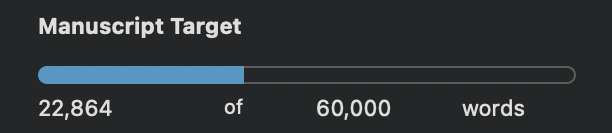
Half-way to my target is getting closer! And I would not mind the novel being shorter, say 50,000 words. Here's where I'm at:
May Feature: Research Trip to Hong Kong
Here's from Wikipedia in its article on cyberpunk:
The cityscapes of Hong Kong has had major influences in the urban backgrounds, ambiance and settings in many cyberpunk works such as Blade Runner and Shadowrun. Ridley Scott envisioned the landscape of cyberpunk Los Angeles in Blade Runner to be "Hong Kong on a very bad day". The streetscapes of the Ghost in the Shell film were based on Hong Kong.
Late last year, I finally got to visit this legendary metropolis, situated on the coast of South China Sea.
Geography and History
Hong Kong is comprised of three larger areas: The New Territories in the north, Kowloon in the middle, and Hong Kong island in the south.
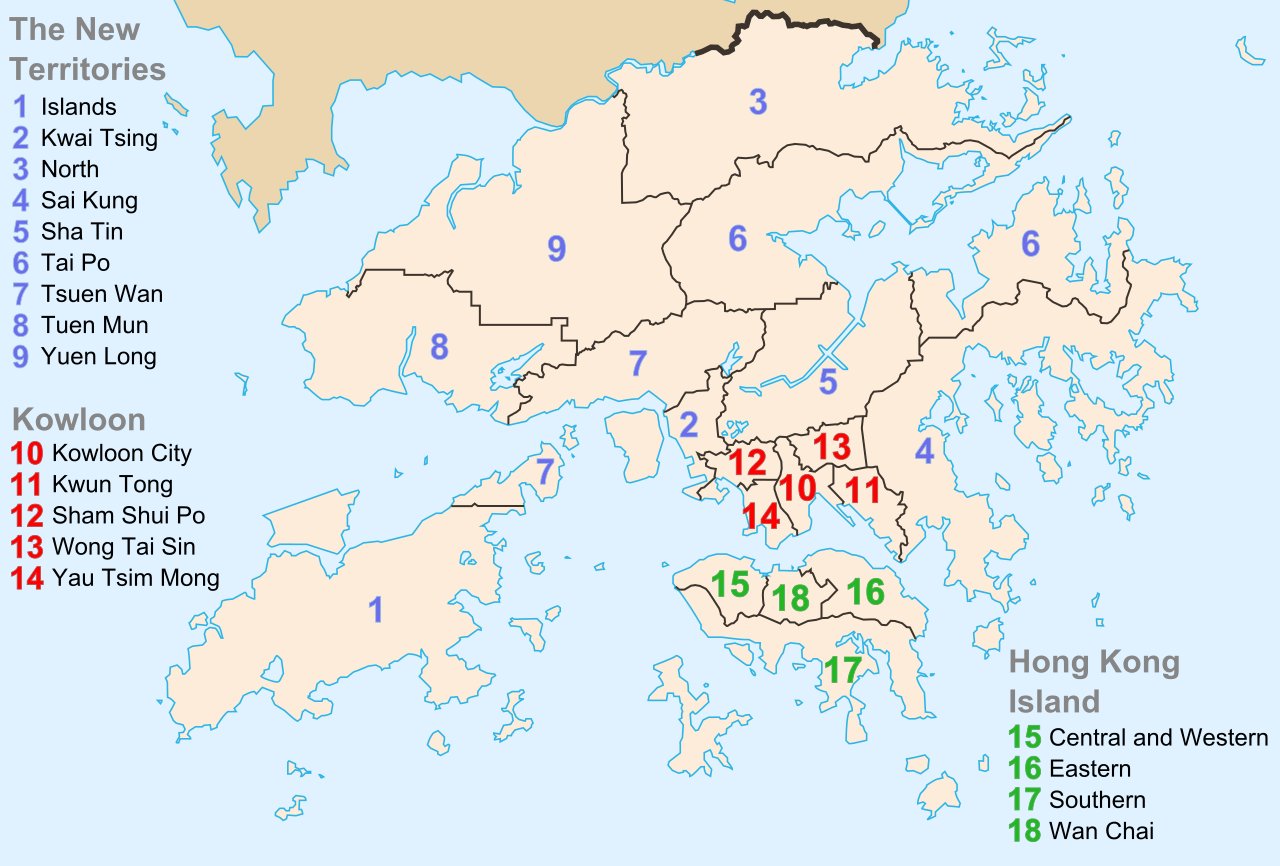
Hong Kong Island was formally ceded from China to the United Kingdom in 1842 as a result of the First Opium War.
The Kowloon Peninsula, sometimes referred to as British Kowloon, was first occupied by the Brits because "thieves, outlaws, and marauders" raided Hong Kong Island and then fled to the peninsula for sanctuary. Then leased to the UK as a result of the Second Opium War. Only 800 people lived there at the time, so certainly not part of a city.
Finally, the New Territories were leased to the British for 99 years, at no charge, in 1898. Many Chinese had migrated to Hong Kong by then, seeking opportunity and fortune, and there was need for expansion. China had just lost a war with Japan and was vulnerable. This enabled the United Kingdom to demand the New Territories.
A hundred years later, in 1997, the lease was up. But the UK not only returned Kowloon and the New Territories, but also Hong Kong Island which was not leased.
By then, the Hong Kong region was a sprawling mega city with an influential stock exchange and a history of cultural influence such as Hong Kong film industry spearheaded by Bruce Lee. And by 1997, cyberpunk was already established, with Blade Runner (1982), Neuromancer (1984), Snow Crash (1992), and Ghost in the Shell (1995) already out.

Bruce Lee from The Big Boss in 1971.
The Mira, or the Snowden Hotel
I stayed at The Mira Hong Kong where Edward Snowden leaked US surveillance secrets to journalists Glenn Greenwald and Ewen MacAskill of The Guardian, and documentary filmmaker Laura Poitras.
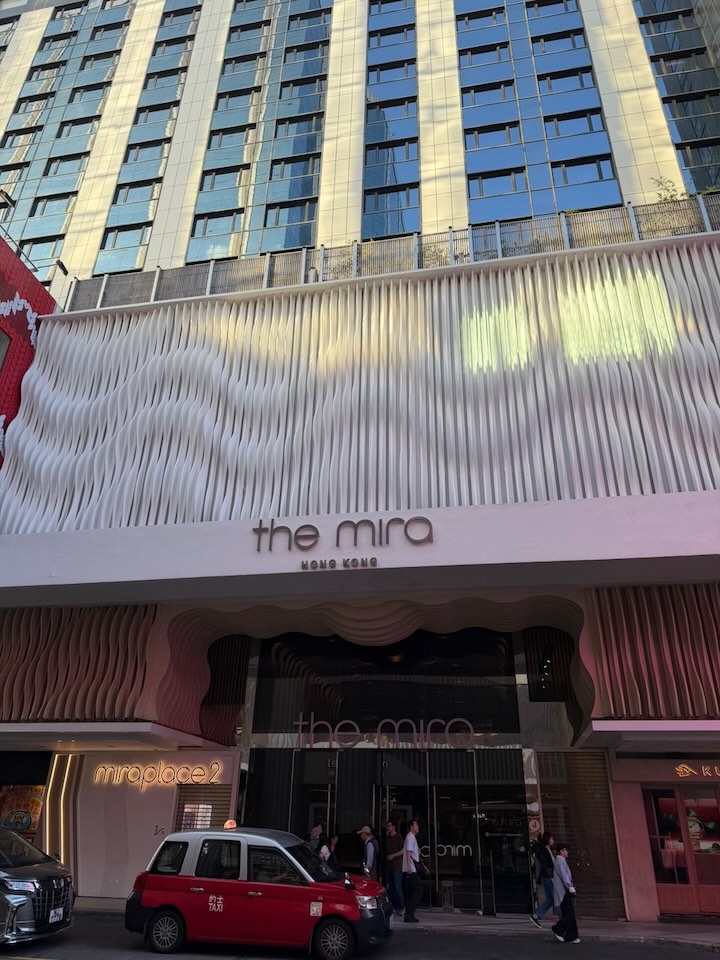
The hotel entrance.
The hotel didn't feature any memorabilia or references to Snowden and I would have been shocked if they did. Instead it was a quite fancy hotel with a steady stream of weddings and young couples taking photos at a waterfall wall in the foyer.
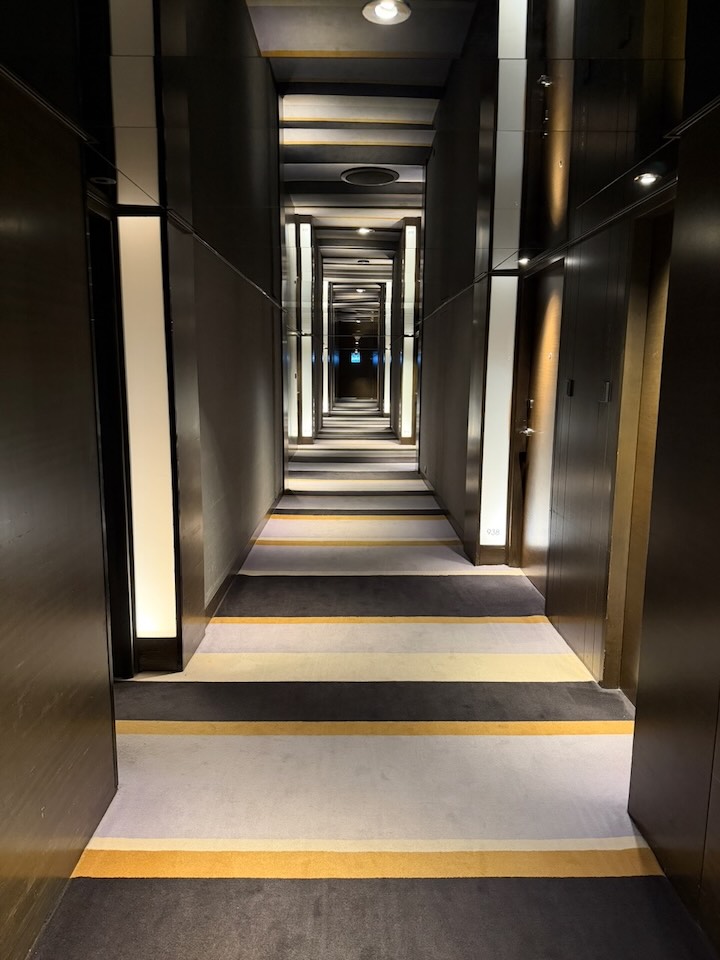
Room-level corridors have mirror ceilings creating an optical illusion of double the height.
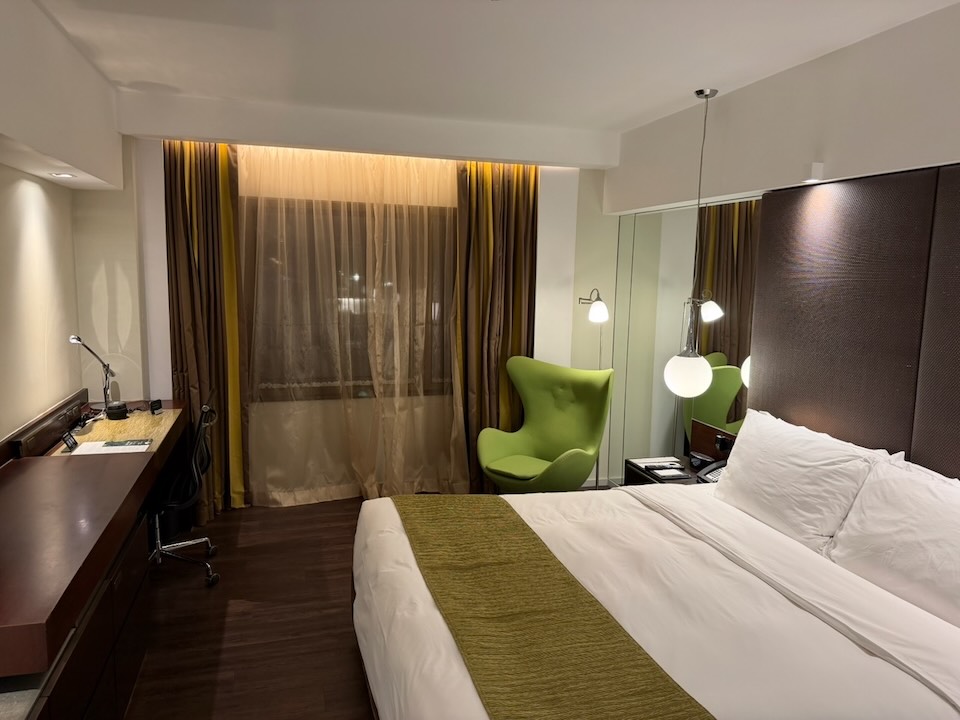
The rooms are color-themed and mine was green. It had a good reading chair which I always appreciate in a hotel.
Kowloon Walled City, the Punk in Cyberpunk
When Hong Kong's New Territories were leased to the UK in the late 1800s, an old imperial Chinese military fort, stone walls and all, was excluded. It was a small enclave of the Qing dynasty. The Brits attacked the site soon thereafter, suspecting that resistance to the lease was organized from the military site. However, there were no soldiers there!
Gradually, the fort fell under British rule, but without governance or care. Over decades, it developed into a lawless piece of land with a crumbling wall around it called Kowloon Walled City. It eventually served as inspiration for the densely populated, slum-like Asian cities you often find in cyberpunk.

An aerial photo of the Kowloon Walled City taken in 1989.
Starting in the 1960s, the British tried multiple times to evacuate and demolish Kowloon Walled City. But the inhabitants resisted fiercely.
By the late 1980s, about 35,000 people lived in the walled city, which means a population density of over a million inhabitants per square kilometer or three million per square mile. It was controlled by Triad gangs (Chinese organized crime), and home to brothels, drug dealers, gambling, use of dogs for human food, and believe it or not, a flourishing industry of unlicensed dentists.
Finally, the UK and China agreed to put an end to it in 1984 as the New Territories lease was running out. Residents were compensated but some had to be forcibly evicted 1991-1992. Demolition concluded in April 1994.

An alley in the city in 1993, after the eviction.
Today, no original structures are left. It's a park and reasonably popular tourist attraction. I must say it's underwhelming. Imagine if they instead would have preserved the walled city and made it safe to explore. That would have been an absolute top notch world attraction. I brought this up with a person in the know, and they said China would just never accept it. That kind of dirty history is not part of the modernity Chinese leadership wants the country to be known for.
Still, having visited the site of this unique (in)human experiment was profound. The only thing that remains is a small ruin of the old city structure in a pit, as seen in my photo here:
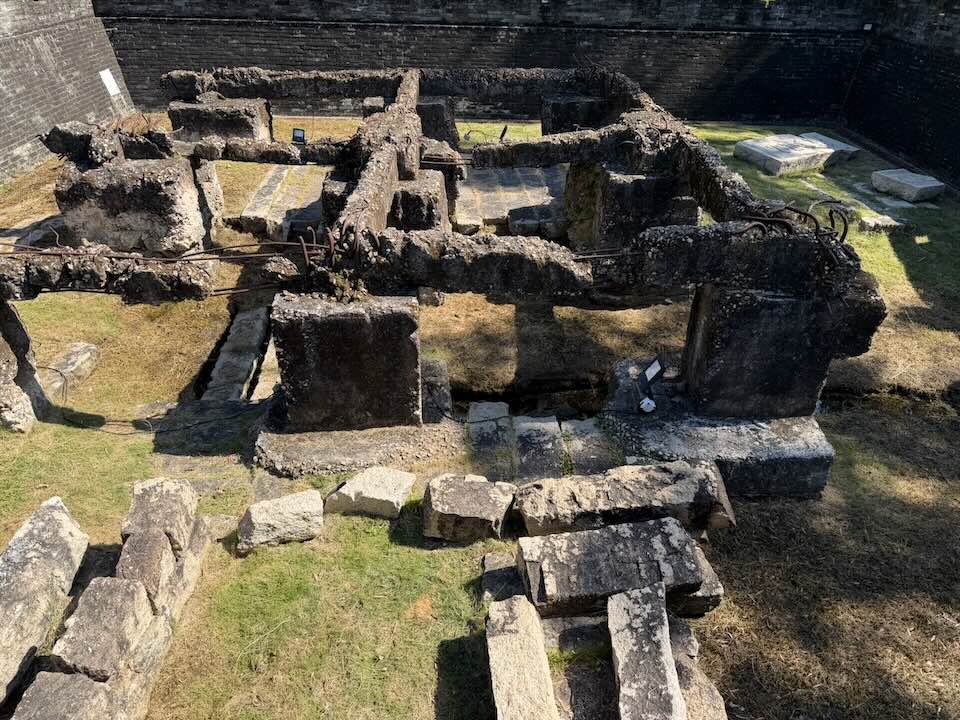
Ruin of Kowloon Walled City.
Ghost in the Shell Scenes
As I write this, I'm listening to the soundtrack of Ghost in the Shell. So much of that cyberpunk anime is about scenery and vibe, and it was all inspired by Hong Kong. Wikipedia:
[Director Mamoru Oshii] based the setting for Ghost in the Shell on Hong Kong, commenting that his first thought to find an image of the future setting was an Asian city, but finding a suitable cityscape of the future would be impossible, and so he chose to use the real streets of Hong Kong as his model.
I wrote a long review of Ghost in the Shell in December 2022. But two specific scenes are worth calling out.
Kai Tak Airport
The British Hong Kong airport was called Kai Tak and was located in Kowloon. A height restriction of 13 to 14 stories was imposed on Kowloon Walled City due to planes heading toward Kai Tak Airport. This is why planes fly so close to buildings in Ghost in the Shell. They were drawing from real life!
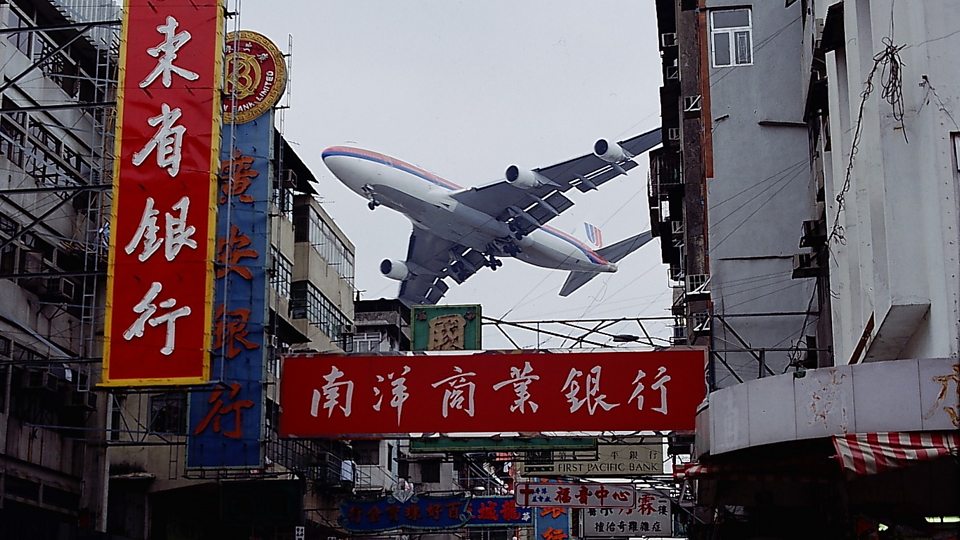
A plane going in for landing low over Hong Kong streets.
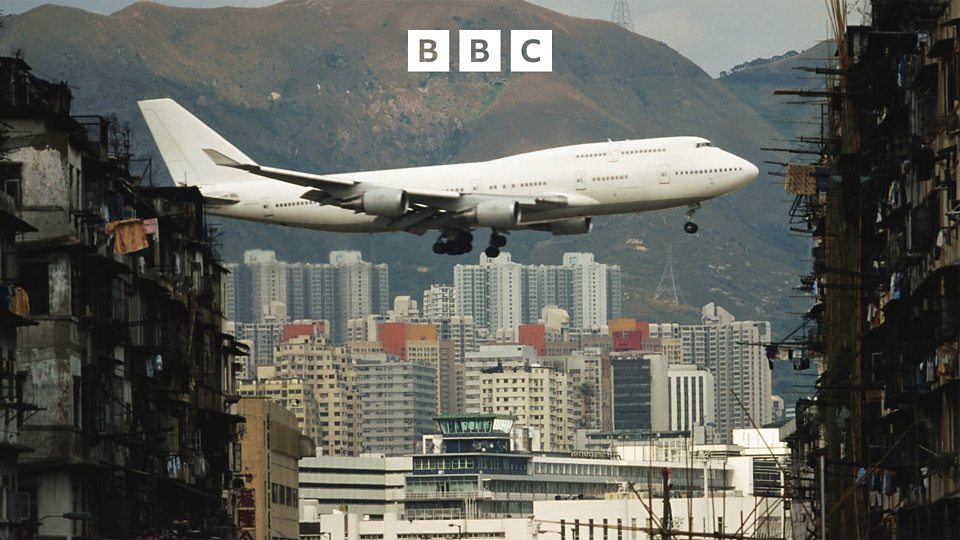
A plane going in for landing with slum-like buildings in the foreground.
Here's a YouTube loop of an airplane low overhead in Ghost in the Shell.
Kai Tak Airport was permanently closed July 1998 when the new Chek Lap Kok International Airport opened outside the city.
Boat Scene and Skyline
The skyline of Hong Kong Island is the most stunning I've seen in my life. Just look at it (my own photo):
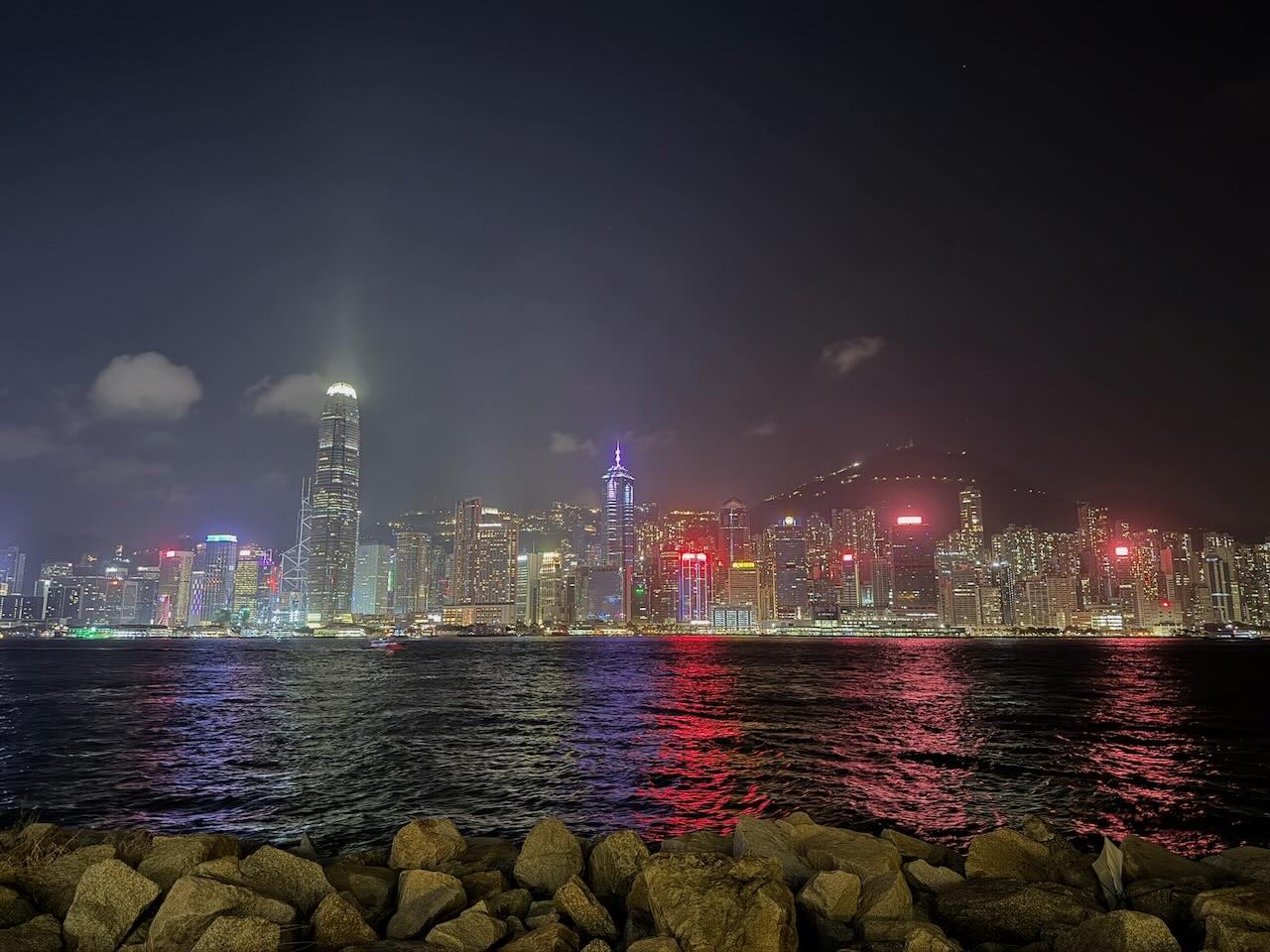
Hong Kong Island skyline. What a beaut!
You might recall from Ghost in the Shell that there's a scene where Major Kusanagi and her sidekick Batou are on a small boat in the middle of the city and Kusanagi goes diving. That's the above skyline. But not only that, there was a similar boat out there when I was admiring the scenery. You can't get much more spot on than that!
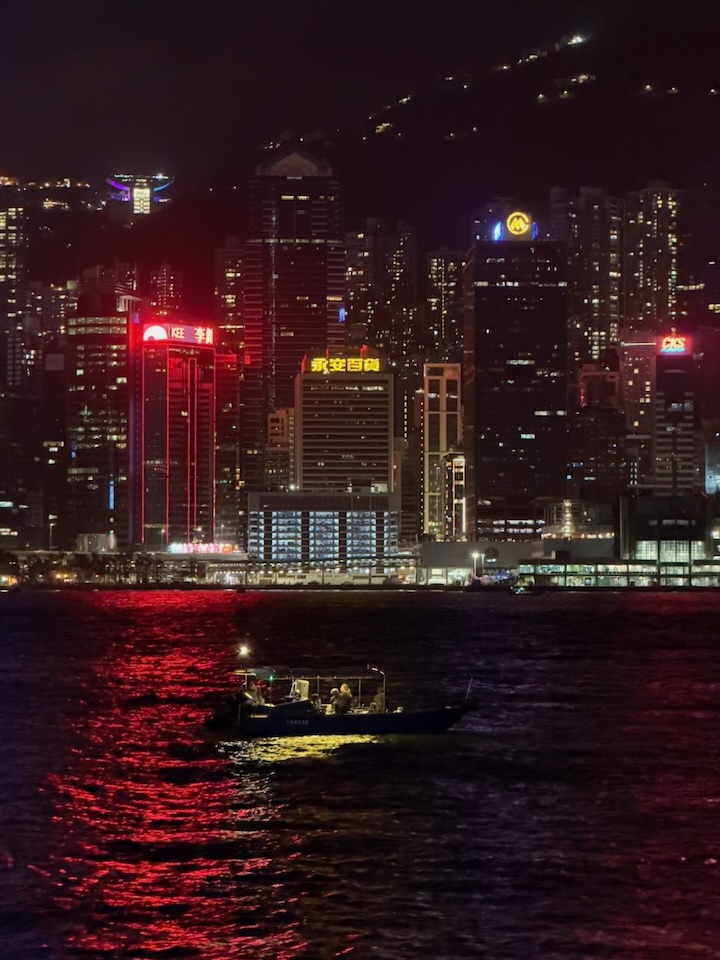
Small boat on the Hong Kong Island waterfront.
Monster Building, and Transformers: Age of Extinction
Finally, the Monster Building. It is the best current example of very dense living and was featured in Transformers: Age of Extinction.
I arrived from the backside of the Monster Building and didn't immediately see the signs telling people to be respectful. But I understand that some people living there don't like how their home has become a tourist attraction, especially not with such a nickname.
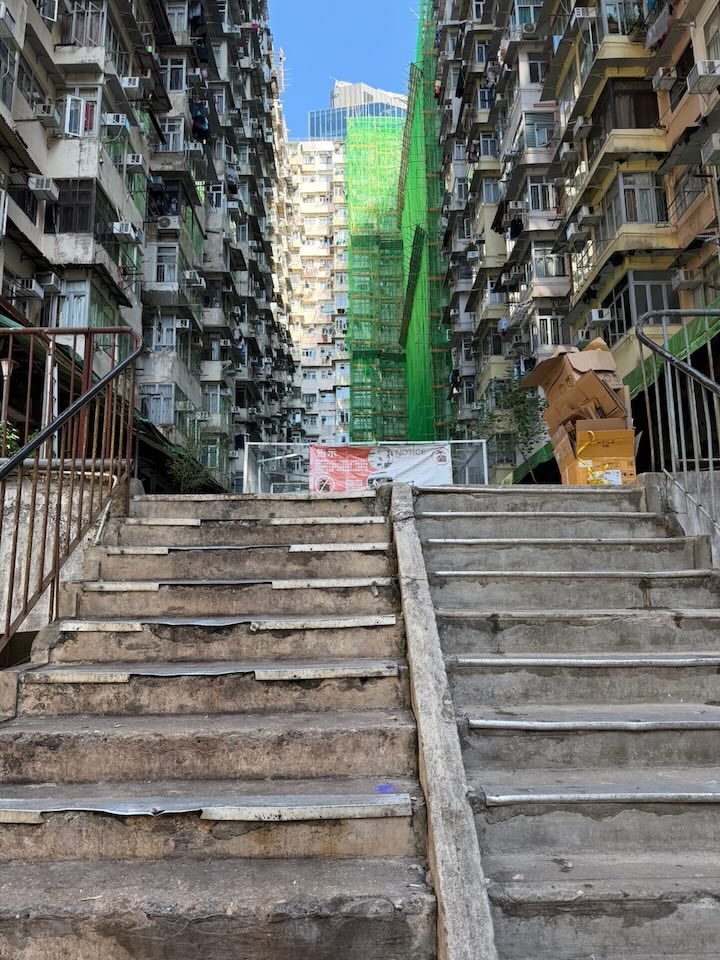
Walking up the stairs to the inner courtyard of the Monster Building.
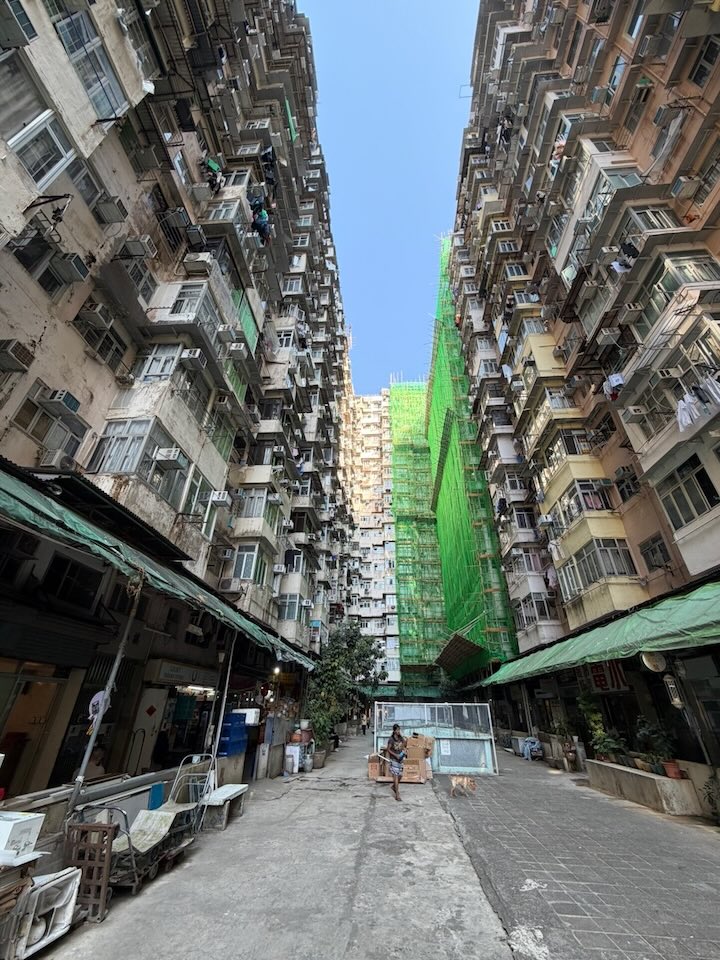
The Monster Building Courtyard.
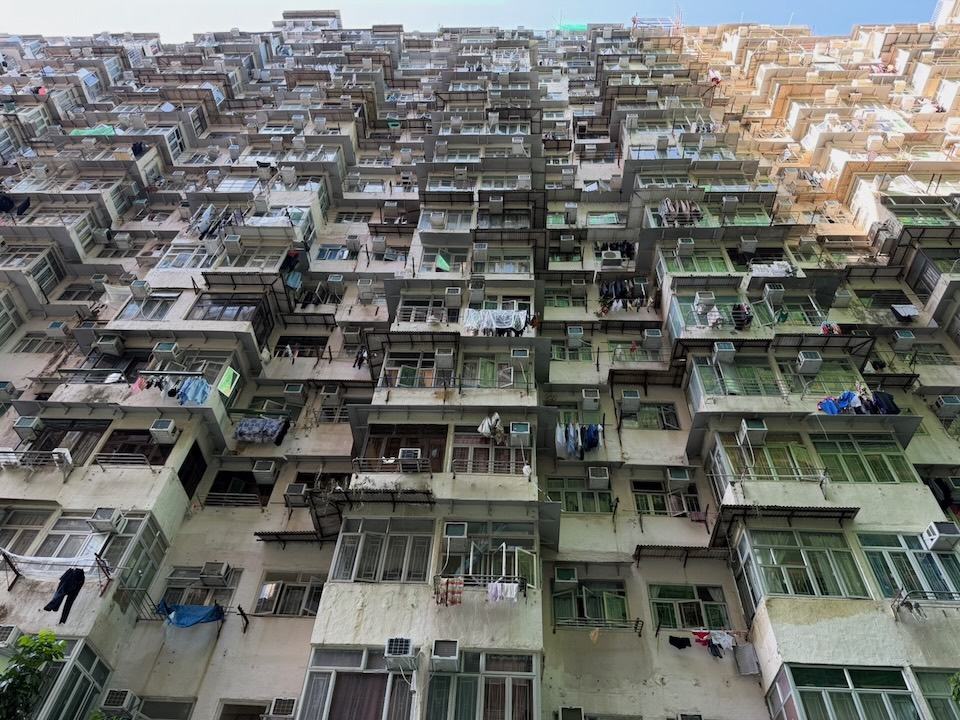
The Monster Building facade.
General Impression
Hong Kong carries a lot of history, obviously well beyond cyberpunk. A century and a half of British rule is still present with subway stations named "Admiralty" and "Prince Edward."
It is a modern city, nothing like the seedy, low-life imaginations of cyberpunk. But its denseness, intensity, and blend of Chinese and English culture still inspires those kind of scenes in my mind.
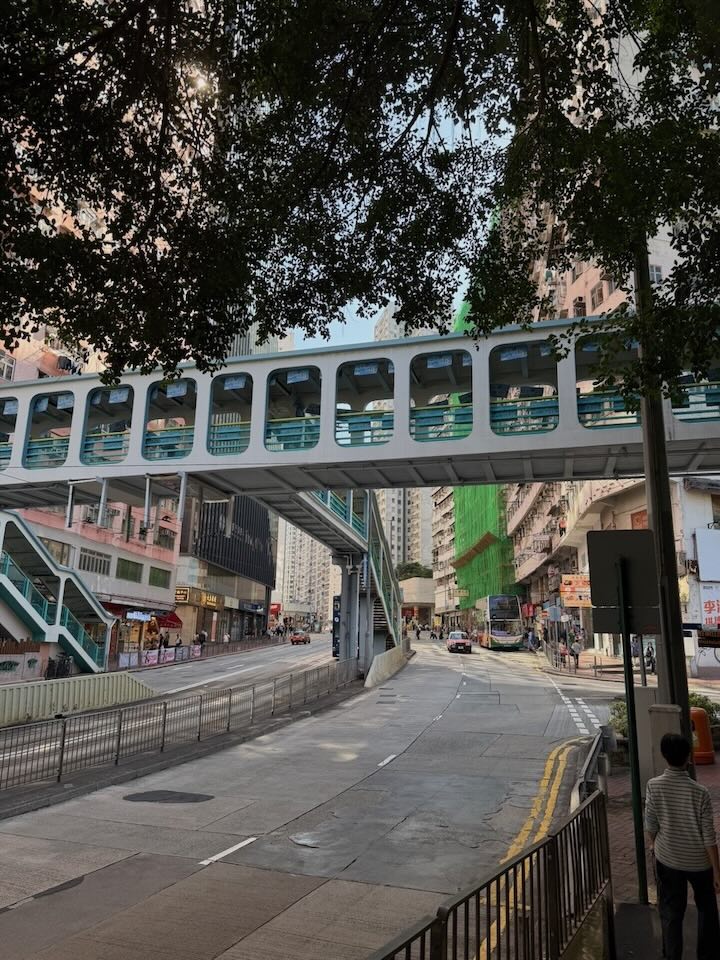
Hong Kong skywalk.
The food was great and public transportation flawless. It's on the expensive side though, with lots of wealthy locals and lots of tourists.
Currently Reading
I finished Ed McBain's Killer's Choice and also read Michael Crichton's The Terminal Man in April.
Right now I'm reading Chris Miller's non-fiction book Chip War: The Fight for the World's Most Critical Technology from 2022.