Read-along Neuromancer, Part 1
Welcome to the December issue of Hacker Chronicles!
This issue begins our three-part read-along of William Gibson's Neuromancer. If you haven't started reading yet, grab a copy and read chapters 1-2. Then you're caught up and can head to the review section.
I was thrilled that my hacker review of Ghost in the Shell was featured in a TechCrunch article on that movie's legacy:
John Wilander, a cybersecurity veteran who writes hacker-themed fiction books, wrote an exhaustive analysis of the movie that highlighted details referencing real-life scenarios. Wilander gave examples, like hackers reusing known exploits or malware to make attribution more difficult, investigating malware without alerting the authors and infecting yourself with it, and using computers for industrial espionage.
And yes, a couple of friends laughed at "cybersecurity veteran."
Oh, the revised version of Cult of the Dead Cow: How the Original Hacking Supergroup Might Just Save the World was released a few days ago. Here it is on Amazon. You might recall I wrote about CDC and the rise of hacktivism in my May issue.
Enjoy!
/John
Writing Update
The audiobook version of Submerged is up for review and should be available shortly! In fact, it's already approved on Kobo. I'll send you a brief notice when it's broadly available. Pasting in over 130 chapter titles one-by-one into a form is a bit mind-numbing, to be honest. Imagine doing it for Audible, then for Kobo, then Spotify, Apple Books, Google Books, … I can't wait for AI to be able to do it for me. I don't trust it to yet.
I haven't been able to write much because a big chunk of November was dedicated to a research trip to Hong Kong and China! Hong Kong is considered ground zero for cyberpunk. I'll feature it, including photos, once we're done with the read-along of Neuromancer.
A kind reminder to please rate and review Submerged on Amazon and Goodreads. It helps a lot in finding new readers. Everyone wants to see ratings first. Thanks!
Read-Along Neuromancer – “Chiba City Blues,” Chapters 1–2
(I know I accidentally wrote chapters 1-4 back in November, but Part 1 is just chapter 1-2.)
William Gibson published two short stories in 1981 that set him up for Neuromancer in 1984. I reviewed Johnny Mnemonic in 2021. That's where he introduces Molly Millions. I also reviewed Burning Chrome the same year, where he establishes the Sprawl and cyberspace.
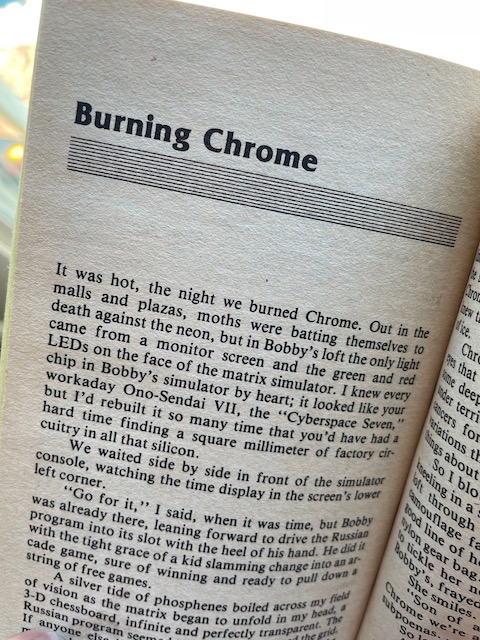
The opening page of Burning Chrome.
A Few Notes on Gibson's Writing
I want to touch on writing style since Neuromancer isn't just great cyberpunk, it's great fiction, period. Take the novel's second sentence:
"It's not like I'm using," Case heard someone say, as he shouldered his way through the crowd around the door at the Chat.
It names the main character and establishes him as male on the fly. Introducing a protagonist is always a challenge, and there are tropes to avoid, such as them looking at themselves in a mirror as an excuse to describe how they look. We don't know much about Case's looks, and we don't need to.
The end of the second paragraph:
The Chatsubo was a bar for professional expatriates; you could drink there for a week and never hear two words in Japanese.
In a single sentence, Gibson establishes that we're in Japan and that Case is a foreigner. He also indicates long drinking sessions and lots of chatter.
Finally, at the games arcade:
Someone scored a ten-megaton hit on Tank War Europa, a simulated airburst drowning the arcade in white sound as a lurid hologram fireball mushroomed overhead.
As a writer, you have these scenes in your mind. You see them. It's tempting to try to get as much of that vision onto the page. But Gibson masterfully avoids describing Tank War Europa. This means we all get to envision it for ourselves and and draws us deeper into the experience that's so unique to reading. We're not served the picture, we are invited to create it.
The Opening Scene's Blend of Old and New
The expats are served draft Kirin. While that is still a popular beer, it doesn't sound right for a place like the Chat with today's eyes. I'd expect more flavorful beer or something to vape. Kirin also doesn't come across as grimy if that's the desired impression.
The reference to a dead channel on the TV is very 80s. Then we got cable and now streaming. I've been a cord cutter since 2014 and our kids have never seen the static of a dead channel.
This isn't me dissing Gibson, just a reflection on how realism changes over decades. As an author of near-future fiction, you have to choose between made up things or grounding your readers in realism. The way my characters use web search in Identified already feels a bit dated given today's chatbots, and I described futuristic search!
There is a bigger picture here. The punkiness in cyberpunk needs to be decaying, grimy, zip-tied, and edgy. And that's not futuristic to me, unless one means a post apocalyptic future. Cyberpunk should be both old and new, and Kirin may be to what we regress.
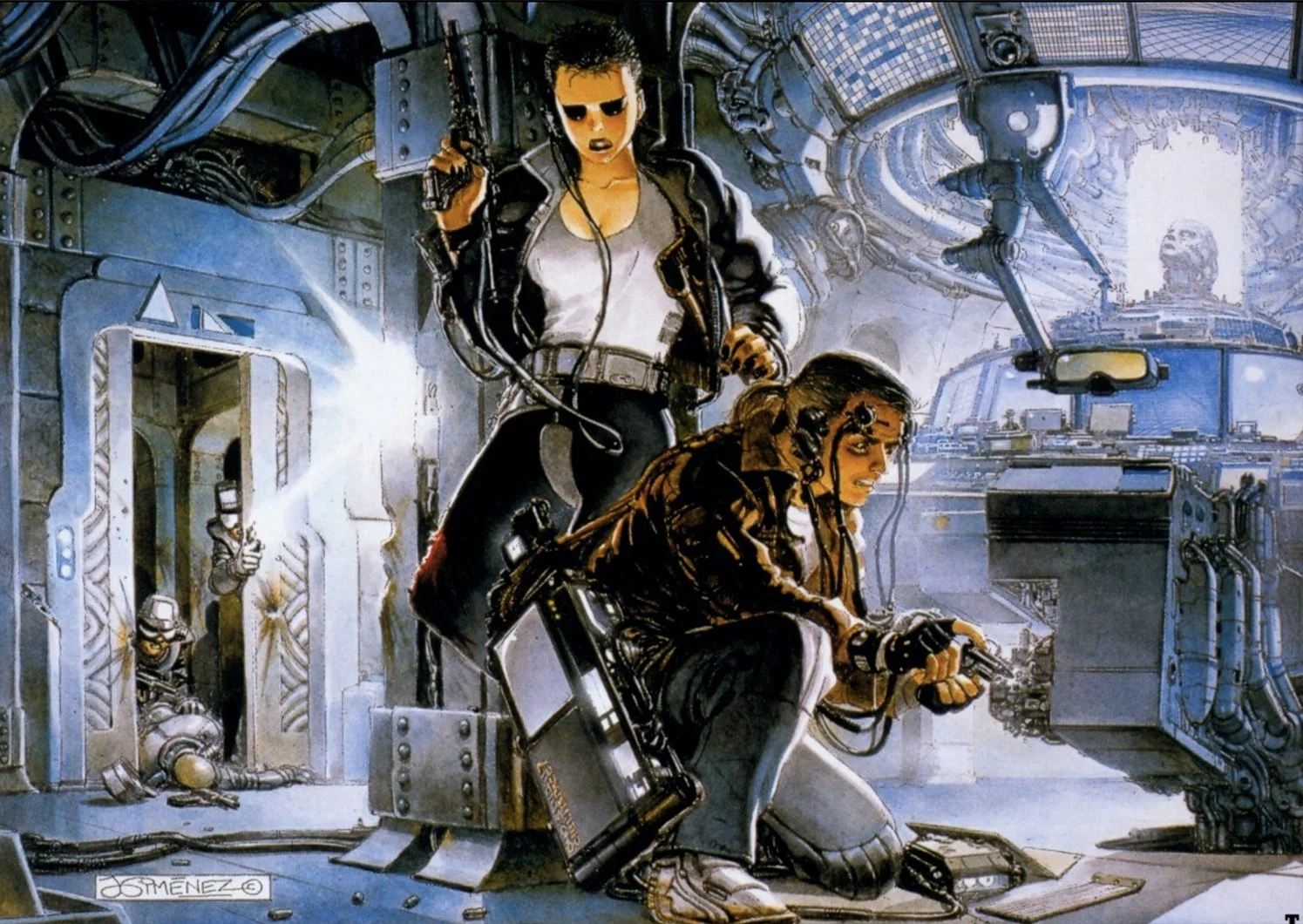
Cyberpunk painting by Juan Gimenez.
A Former Cyber Cowboy
We learn that Case was once a skilled hacker with custom hardware access to a virtual cyberspace.
At twenty-two he'd been a cowboy, a rustler, one of the best in the Sprawl (…) jacked into a custom cyberspace deck that projected his disembodied consciousness into the consensual hallucination that was the matrix.
But he skimmed money behind his employers’ backs and they took their revenge.
Because—still smiling—they were going to make sure he never worked again. They damaged his nervous system with wartime Russian mycotoxin (…) his talent burning out micron by micron
Now he's hustling in Chiba, convinced that he could cure his nerves in Japan but they would never accept his paper New Yen.
The Drugs and Dirt
The characters around Case, and himself, are sweaty, dirty, and either high on drugs or drunk. Only those giving orders rather than taking them are dressed in suits and don't reek of going unwashed.
Threading his way through the Ninsei crowds, he could smell his own stale sweat.
The grime of cyberpunk.
Hacker culture has long been laced with drugs. Mr. Robot incorporated that aspect. But there's a balance between getting high as escapism and enhancing one's senses. Case is not getting wasted; he needs his octagons to keep going. I talked about this in my "Hacking Genes and Brains" issue in 2022.
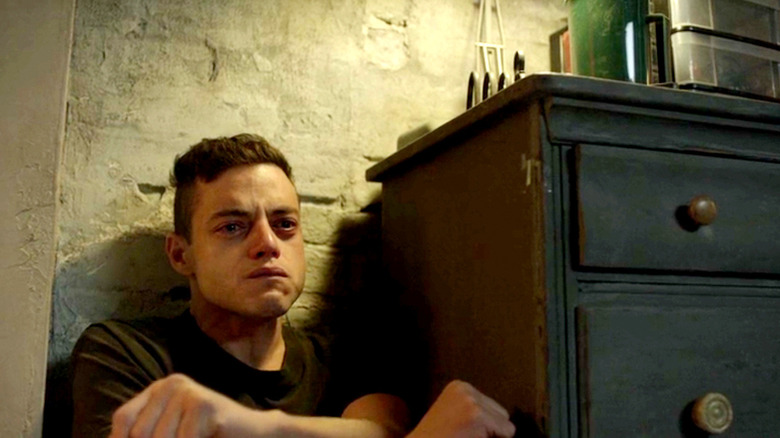
Elliot in a drug use scene of Mr. Robot.
A Second Chance
Molly finds Case and takes him to Armitage, a wealthy man who knows Case’s past. He wants Case back at full capacity for a job in the matrix. Case used to be an icebreaker – breaking ICE, Intrusion Countermeasures Electronics.
You might recall how the burning in Burning Chrome is about breaking ICE. From my review:
Jack has gotten his hands on a Russian military virus so capable that they have to hold it back. They ride in like cyber cowboys and tear down initial defenses before they reach Chrome’s heart. The heart is defended by black ice – ice that kills – only defeatable by the Russian virus.
Case is offered treatment that will reverse the damage to his nervous system, fix his pancreas and liver after all the drugs, and get him ready to jack in again.
Case accepts.
This is a classic story—a broken hero of the past being brought back for one last job.
Next Up
In the next newsletter issue, we'll review Part 2 “The Shopping Expedition” and Part 3 “Midnight in the Rue Jules Verne” which total at about 100 pages.
Currently Reading
I'm still reading The Matarese Circle (1979) by Robert Ludlum.
And of course Neuromancer. :)