Read-along Neuromancer, final parts
Welcome to the February issue of Hacker Chronicles!
This issue concludes our three-part read-along of William Gibson's Neuromancer.
In my March newsletter, I'll do a deep dive on the Arctic research I did for my novel Submerged. Greenland, submarines, the G-I-UK Gap, and North Atlantic security are high on the international agenda today. I'll do my best to steer clear of the sad political state of those things and be mindful not to take advantage of the present day agenda, but it feels relevant since I spent a couple of years looking into Arctic security. If you haven't read or listened to Submerged yet, you should—there will be spoilers.
Enjoy!
/John
Writing Update
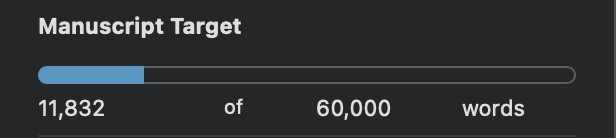
Writing out of order has become a little easier because I've been able to nail down the plot further. But there's still that familiar decision point every time I sit down to write.
Last weekend I went to a writers meetup at a café in Sunnyvale. Just over a handful of local folks. It's such a joy to have a community. I provided some feedback on a draft blog post and got some writing done myself.
Here's where my next novel currently stands:
Read-Along Neuromancer – Final Chapters
This is the third and final part of my review of William Gibson's seminal cyberpunk novel Neuromancer.
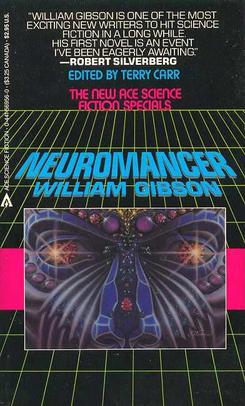
The original cover of the novel.
The first review segment was in my December issue and the middle review segment was in my January issue.
Psychedelic Scenes
Neuromancer really is a two-part novel. One part cyberpunk, one part loopy space sci-fi.
I'm impressed by Gibson's imagination, creating cyberspace and the mind-bending space stations. I even speculated that Gibson might have been on psychedelic drugs to produce these scenes. But from what I can find, that really wasn't the case.
Here's a quote published by Vice:
“My drug of choice during the composition of Neuromancer, was O'Keefe's Extra Old Stock Lager, a central nervous system depressant, employed primarily to manage the anxiety of composition, and not a practice I'd particularly recommend to anyone considering taking up writing.”

Gibson has also talked about what he was trying to achieve with the speculative setting of Neuromancer. Here's from a transcript of an interview at the New York Public Library on April 19, 2013 (pdf):
I wanted the evocative—evocation is an important part of science fiction and fantasy for me. The calling, if only calling the image of something unreal into being in the reader's mind for a moment has always seemed to me to be like a great hack, it's a fun thing to do if you can, if you can do it, so I was evoking, I was evoking that, but there really wasn't any particular part of me that was like, “Oh, I really want this to happen, I really want this equipment, I want these machines.” That wasn't it. I wanted to induce something in the reader, but it came as a sort of shock to me when I started to meet people whose relationship to my first novel was like, “Holy shit, I want all this stuff right now. Why is my computer so slow?”
Molly's Backstory
Up in space, the team gets ready for the Tessier-Ashpool hack, on Armitage's command. Riviera annoys the heck out of Molly at a fancy restaurant with a holographic, sexual show, depicting her. She leaves Case and isolates herself to get ready for the final assignment.
Case finds her in a different hotel and she shares how she became what she is. There's backstory that Gibson had already published a couple of years earlier.
You might recall my review of his short story Burning Chrome, where I wrote: "Chrome launders money for organized crime and runs a brothel where women can submit their bodies to customers while mentally checking out."
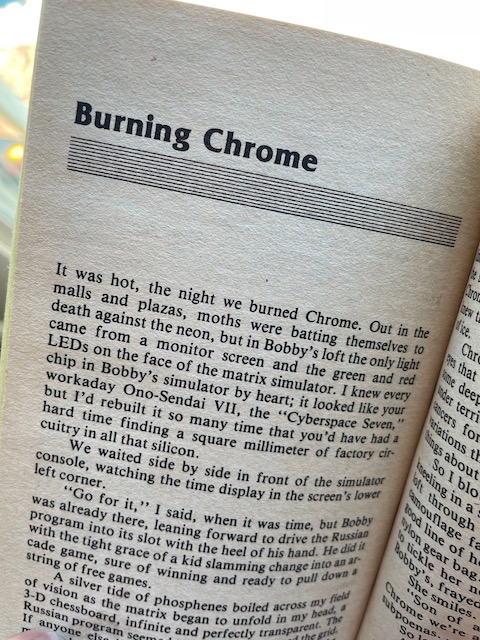
The first page of the short story Burning Chrome.
Molly tells Case that she used to be one of those prostitutes working for Chrome. But the sex work started bleeding into her dreams, giving her nightmares of horrible, deprived things.
She used the money she earned as a prostitute to enhance her body cyborg-style. That's how she got her retractable razor nails. Chrome caught wind of it, installed some bad software in her, and started renting her out for illegal sessions at eight times the price. Eventually her "cut-out chip" flaked out in a session where a senator was murdering another woman. She used her cyborg capabilities to kill the senator and had to go into hiding with a price on her head.
A few chapters later, Molly tells Case that he reminds her of an old boyfriend named Johnny. That's Johnny Mnemonic from the short story and movie of the same name! See my 2021 review. We learn that Johnny was eventually killed for what he did in that story.
In the movie Johnny Mnemonic from 1995, the woman who helps him is called Jane. But she's Molly Millions in the short story and the same Molly in Neuromancer.
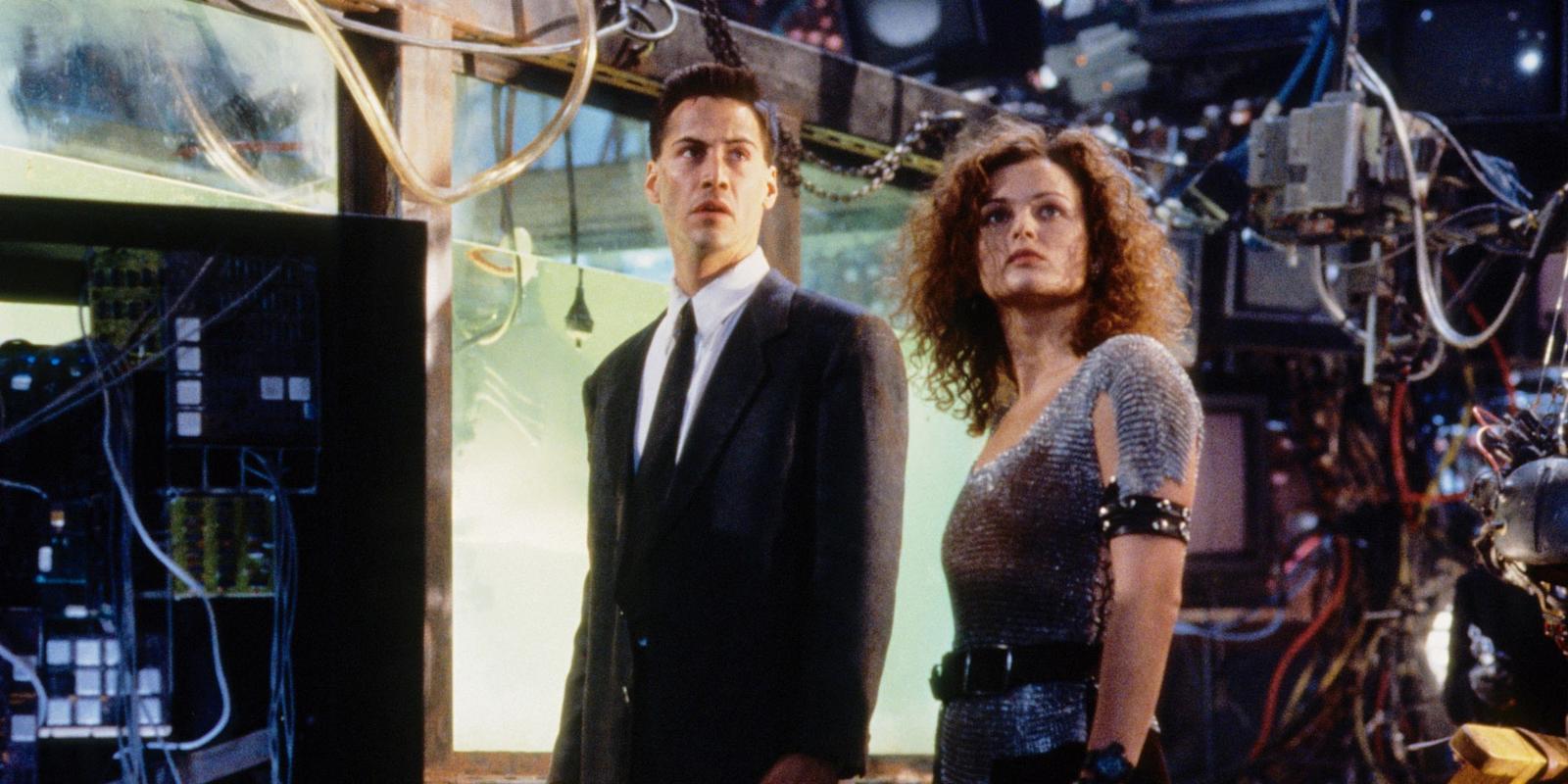
Johnny Mnemonic (Keanu Reeves) and Jane (Dina Meyer) in the movie.
Thoughts
Molly's past is of course super dark, but it fits into the tragic state of things in Chiba. It's very likely that sex workers would want to use cut-out chips if they existed in real life.
I love how Gibson weaves in two of his original cyberpunk stories into Neuromancer. The series later referred to as The Sprawl was coming together.
Blanking out memories reminds me of the Oscar-winning movie Eternal Sunshine of the Spotless Mind starring Jim Carrey and Kate Winslet. It is dark in its own right. Gosh, it was a long time since I saw that movie.
The Chinese Virus
Kuang Grade Mark Eleven, the military-grade virus, or icebreaker. It's the tool Armitage acquires for Case and the Dixie Flatline construct. It's a slow virus that needs hours to crack a military target or an AI.
I've been thinking about what makes a hack slow. It could be an exhaustive search of a key space to break encryption. But that doesn't feel like a virus. There are also denial-of-service attacks that take time, such as Slowloris. That sounds more like it, slowly eating up more and more of the ice's capacity until it can't detect the real attack that's coming. Another variant of such a denial-of-service attack is the billion laughs attack where self-referencing makes a small data structure blow up in memory size.

Slowloris running on Command Prompt.
The Tessier-Ashpool Family
The target of The Straylight Run hack is the compound and reign of the Tessier-Ashpool family. Ultra rich, self-isolating, and hoarders of human culture.
The mother in the family was the one who created artificial intelligence to run things. She's long dead. The father has frozen himself to get eternal life and wakes up now and then to check in on things. At least that's my understanding but Gibson's compressed, psychedelic writing bends things.
Thoughts
While there are super rich families who like to distance themselves from the 99%, I don't think control over powerful technologies has fallen in the hands of families. It's individuals and companies. Probably armies too, although a lot of that technology is secret.
Two Artificial Intelligences
As The Straylight Run unfolds, i.e. the final hack, we learn that there's a second AI called Neuromancer. The AI called Wintermute is the planning and scheming one who sets up Armitage, Molly, Case, and Riviera to hack Villa Straylight. The AI called Neuromancer represents personality and emotion. Wintermute is compelled to unite with Neuromancer which is the ultimate goal of the hack.
As the final scenes progress, it really is the Wintermute AI that drives the plot. Molly, Case, and Case's Rastafarian companion, Maelcum, are merely vessels needed to perform the physical intrusion.
Thoughts
AI communicating and scheming with other AI is featured in Colossus: The Forbin Project, where two superpower AIs start communicating (see my review from 2022).
AIs fighting each other also exists, for instance in Terminator 2: Judgment Day.
Underlying is the endless fear we have of the machines taking control.
"He Never Saw Molly Again"
Gibson has said that he added the novel's final sentence "He never saw Molly again" to prevent himself from writing a sequel.
Both reading that sentence and hearing Gibson's reason for it makes me sad, but sad in a rewarding way! Fiction has too few such moments. Emotional finality. I already know the final moment for my lead character West. I've known it since well before I was done with my first novel. It will be the end once I write it.
Take the way Frodo sails away in the end of The Return of the King, and we know he'll never see Sam or the Shire again. That's sad and beautiful.
That's why I'm still upset with how the movie Source Code ended. Some of you might recall that I refused to cover the ending in my review.
The Shuriken Fourth Wall
I wanted to comment on a small narrative thing.
Case desires a throwing star weapon called a shuriken, and Molly gifts him one early in the book. That is the metaphorical "hang a gun on the wall," which according to the rules of fiction writing needs to be fired later in the story for the setup to pay off.

Different types of shurikens.
But Case never uses his shuriken! Even though Gibson reminds the reader of it repeatedly, for instance that it's lying in his pocket. You keep thinking there will be a scene where he's about to die and then pulls off a great comeback with the shuriken, but no.
In the final scene, Gibson instead kind of breaks the fourth wall, at least for us fiction authors, by Case explicitly saying he doesn't need the shuriken. He ultimately throws it into the wall screen but that's utterly underwhelming.
This made me think of Neal Stephenson's totally fourth wall-breaking name of the main character in Snow Crash: Hiro Protagonist, pronounced "Hero Protagonist."" That still messes with me.
Snow Crash will likely be our next read-along, but that's a bit out. I'm thinking we'll do read-alongs over Thanksgiving and Christmas. Once a year is a good cadence.
Final Thoughts
I've mentioned it several times – Gibson's writing is very compressed. It takes focus to read and absorb. I tried to listen to Neuromancer as an audiobook years ago and it didn't work. There's even some of Hemingway's iceberg theory going on, where the reader is given just enough to fill in the blanks and understand what's going on.
What I call the psychedelic space part of the story is pretty far from my own writing. I'm very concrete and realistic in comparison. I do like the dirty Chiba part of Neuromancer better. That's the kind of dystopic tech-infused future I love in cyberpunk.
It's nothing short of stunning how far ahead Gibson was in envisioning the future back in 1983 when he wrote the novel. A lot of it has happened or is happening. Some is still a vision, like the simstim. The only central thing he didn't envision was cellphones, which he has commented on.
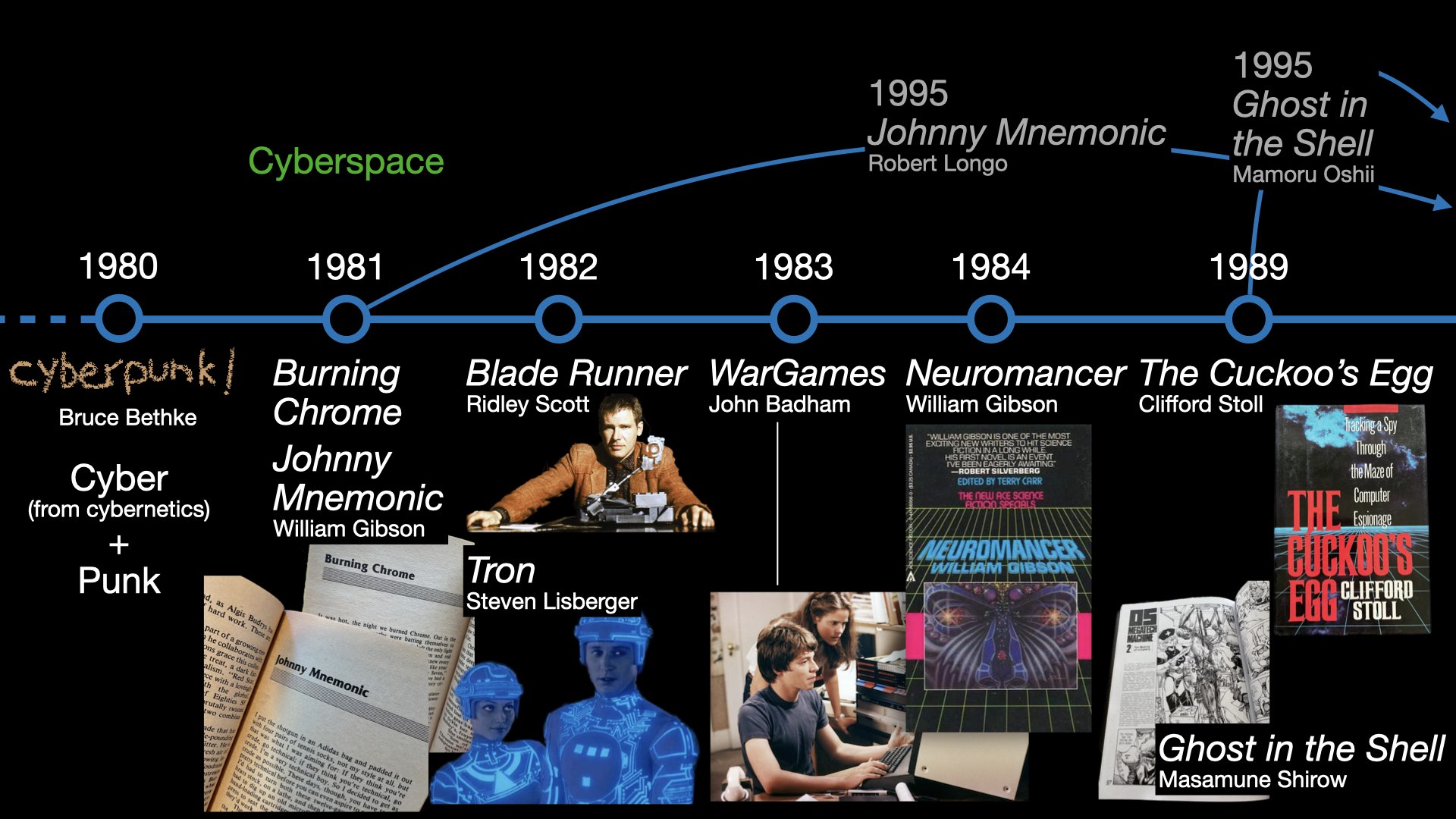
Looking at the wave of great hacker fiction that came out around that time, it's not surprising that Gibson managed to synthesize it all into this one novel. You know it from my timeline:
- 1980: The Cyberpunk short story by Bruce Bethke, coining the genre's name
- 1981: Gibson's short stories Burning Chrome introducing cyberspace, and Johnny Mnemonic setting the stage for the Sprawl
- 1982: Blade Runner exploring human-like machines, and Tron taking humans into a virtual world
- 1983: War Games with a hacker as the hero, featuring the love of the machine
- 1984: Neuromancer
I'm really looking forward to the upcoming TV series on Apple TV! They've been filming for more than a year.
I'd love to know what you thought of (re)reading Neuromancer! Just email me.
Currently Reading
I finished not only Ed McBain's Cop Hater but also The Mugger which is second in his very long 87th Precinct series. I'm almost done reading the third, titled The Pusher. They're great police procedurals, set in a fictional version of New York City in the 1950s.