Arctic Research for "Submerged"
Welcome to the March issue of Hacker Chronicles!
As promised, this issue will cover a lot of the Arctic research I did for my novel Submerged. Greenland, submarines, the G-I-UK Gap, and North Atlantic security are high on the international agenda today. If you haven't read or listened to Submerged yet, you should because there are spoilers below.
Enjoy!
/John
Writing Update
February had multiple things eating my writing time. First, the kids had their winter break and we went on a trip to Las Vegas, Grand Canyon, Sedona, and Phoenix. Sedona was the best part of it for me. What a beautiful place!
We had barely gotten back home when our oldest daughter and I came down with the seasonal flu. I hadn't had the flu in almost twenty years and you tend to forget how long it takes to get well again. I lost a week. That then meant I was so far behind at work that I had to catch up. Oh, well.
I have an exciting thing coming up which is to draw notes by one of the characters. It's an element of procedurals that I like.
Here's where my next novel stands:

March Feature: Arctic Research for Submerged
Spoiler alert: This feature contains several spoilers for my novel Submerged.
The Norwegian Submarine Base Olavsvern
The north coast of Scandinavia, i.e. the coast of the Norwegian Sea and Barents Sea is comprised of only two countries – Norway and Russia. Neither Sweden nor Finland have northern coastlines. This makes Norway a key member of the North Atlantic Treaty Organization. Their northern coast and Arctic waters and islands are the northern border between NATO and Russia.
Norway has an underground submarine base well above the Arctic circle close to the city of Tromsø. It's called Olavsvern.
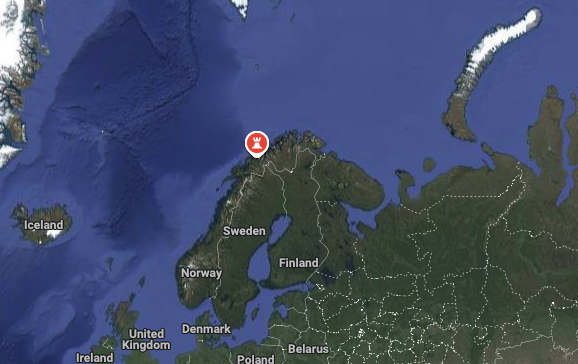
A map showing Olavsvern on the Norwegian Arctic coast.
During what was referred to as "the peace dividend," Norway not only decommissioned Olavsvern, but it was ultimately rented by companies from Russia linked to state-owned Gazprom. Suspected Russian military activity aboard research vessels ensued.
Norway bought it back in 2019 and since 2021 it's back in military use within NATO.

A photo of the sea-level entrance into the mountain.
This is the place where West and Jitterbug get their training and eventually board the Dolphin II headed for Novaya Zemlya.
I had already written the chapters featuring Olavsvern when the car show The Grand Tour had an episode with Jeremy Clarkson, James May, and Richard Hammond driving inside the underground naval base! Since I had read so much about it, I realized immediately where they were and I of course made good use of the footage to refine my scenes.
The Loophole and the Banana Hole
A country's claims of sea water go maximum 200 nautical miles from land. The multitude of Arctic islands up in Barents Sea means a lot of the water is spoken for, at least as exclusive economic zones. Norway and Russia have direct maritime borders all the way up to the Arctic ice. But there is a space in the middle of Barents Sea that's more than 200 nautical miles from any landmass and it's called the Loophole.
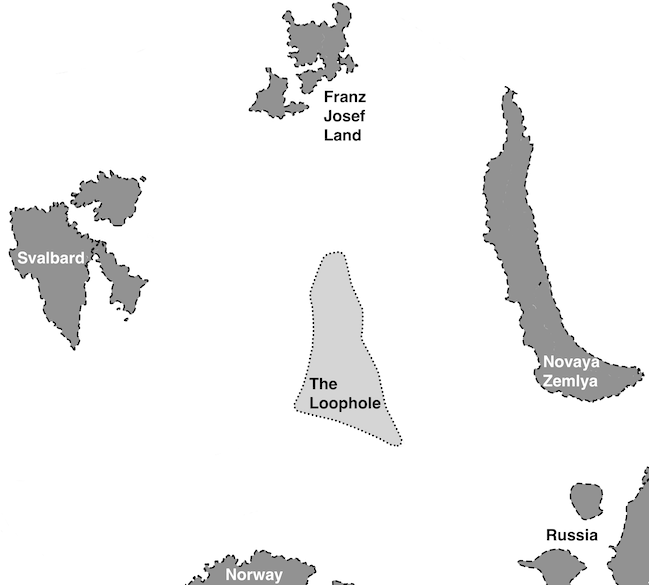
My book's map of the loophole.
The Loophole is international waters and Åse makes use of it to delay their entry into Russian waters in my book.
Similarly, the sea space between Norway, Iceland, and the Faroe Islands (part of Denmark) form the Banana Hole.
Novaya Zemlya and Tsar Bomba
The large Arctic island of Novaya Zemlya has fascinated me since I was a child. I just had to feature it in one of my books. It is considered part of Europe, the extreme northeast of Europe, that is.
It's 83,000 km2 which is the same size as Austria and a bit larger than Ireland.
Belushya Guba is its administrative center with a population of about 2,000, mostly military personnel associated with the nuclear test sites.
The Cold War nuclear tests are what the island is most known for. The world's largest nuclear blast – Tsar Bomba – was executed there in 1961. I mention it in the book when they talk about going there.
Russia has released video footage of the blast: YouTube
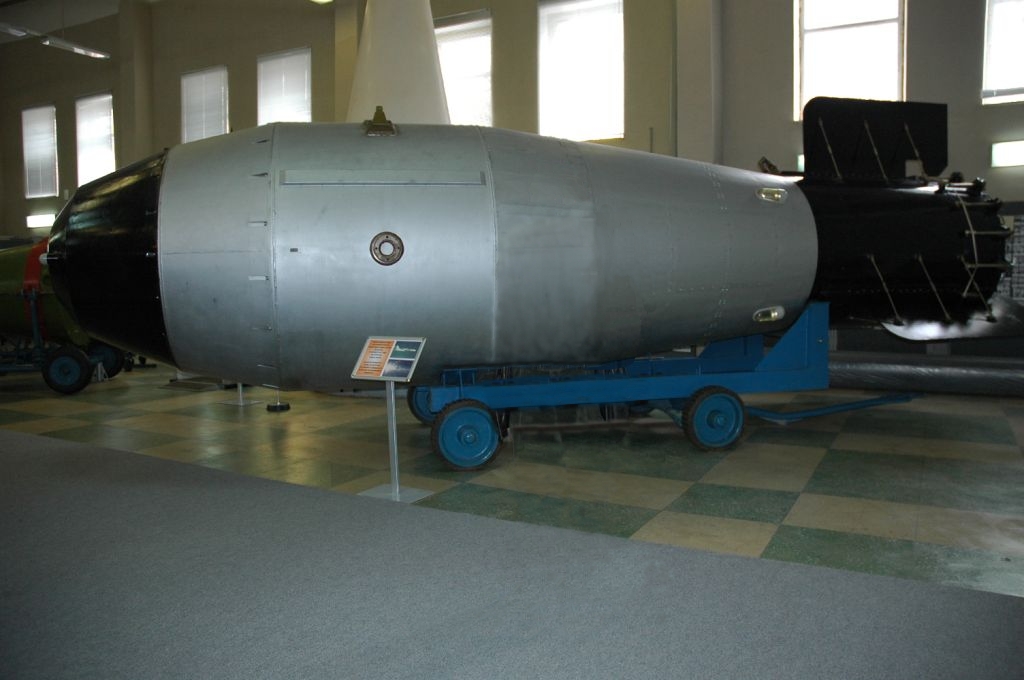
A Tsar Bomba-type casing on display at the Sarov atomic bomb museum.
I got a DVD copy of the Russian movie Новая Земля or Terra Nova. It is set in a dystopian future (2013) where prisoners are sent to Novaya Zemlya to survive as best they can. It has vibes of The Lord of the Flies and Battle Royale, and helped me set the scene for Ice Dolphin.

The movie poster of Terra Nova.
The Lomonosov Ridge and the Gakkel Ridge
I did a lot of research into submarine navigation under the Arctic ice mass. That's when I came across the dispute around the Lomonosov Ridge. It's an underwater ridge of continental crust going right past the North Pole. Russia filed a claim to the ridge to the UN in 2001. More recently, Denmark has claimed it's an extension of Greenland. A third contender, Canada, asserts that the ridge is an extension of its continental shelf.
West doesn't reach the Lomonosov Ridge but the Gakkel Ridge which is closer to Novaya Zemlya and Svalbard.

Main topographic features of the Arctic Ocean floor.
Nagurskoye Air Base
Russia's northernmost military base is Nagurskoye Air Base on the western-most island of Franz Josef Land. It is extremely far up in the Arctic and was originally built in the 1950s for Soviet bombers to reach the US by flying over the North Pole. The base is actively maintained and satellite footage shows recent expansion with new runways.

The Nagurskoye Air Base.
West navigates to it on his way north because it's a preset destination on his Dolphin II submarine. It is also where the Russian submarine Magnitogorsk starts its pursuit of West.
Militarization of the Arctic
The militarization of the Arctic is an ongoing development and global warming is changing the rules of the game with less ice, especially during the northern hemisphere's summer months.
It's not just about the shortest distance between Russia and the US East Coast, but also about natural resources and access to the North Atlantic.
In 2018, China declared an official Arctic policy calling itself a "near-Arctic state."
One of the most fascinating things I came across in my Arctic research is the global supply of icebreakers. 80% of the world’s icebreakers are designed by Finnish firms and more than 60% of icebreakers are built in Finnish shipyards (see article from the Wilson Center). Russia bought more and more of the Finnish production capacity, starting in 2010, but eventually had to divest because of US sanctions. Russia's full scale invasion of Ukraine in 2022 and Finland's asscession to NATO in 2023 put a definite end to Russian ownership and since then Canadian investors have stepped in.
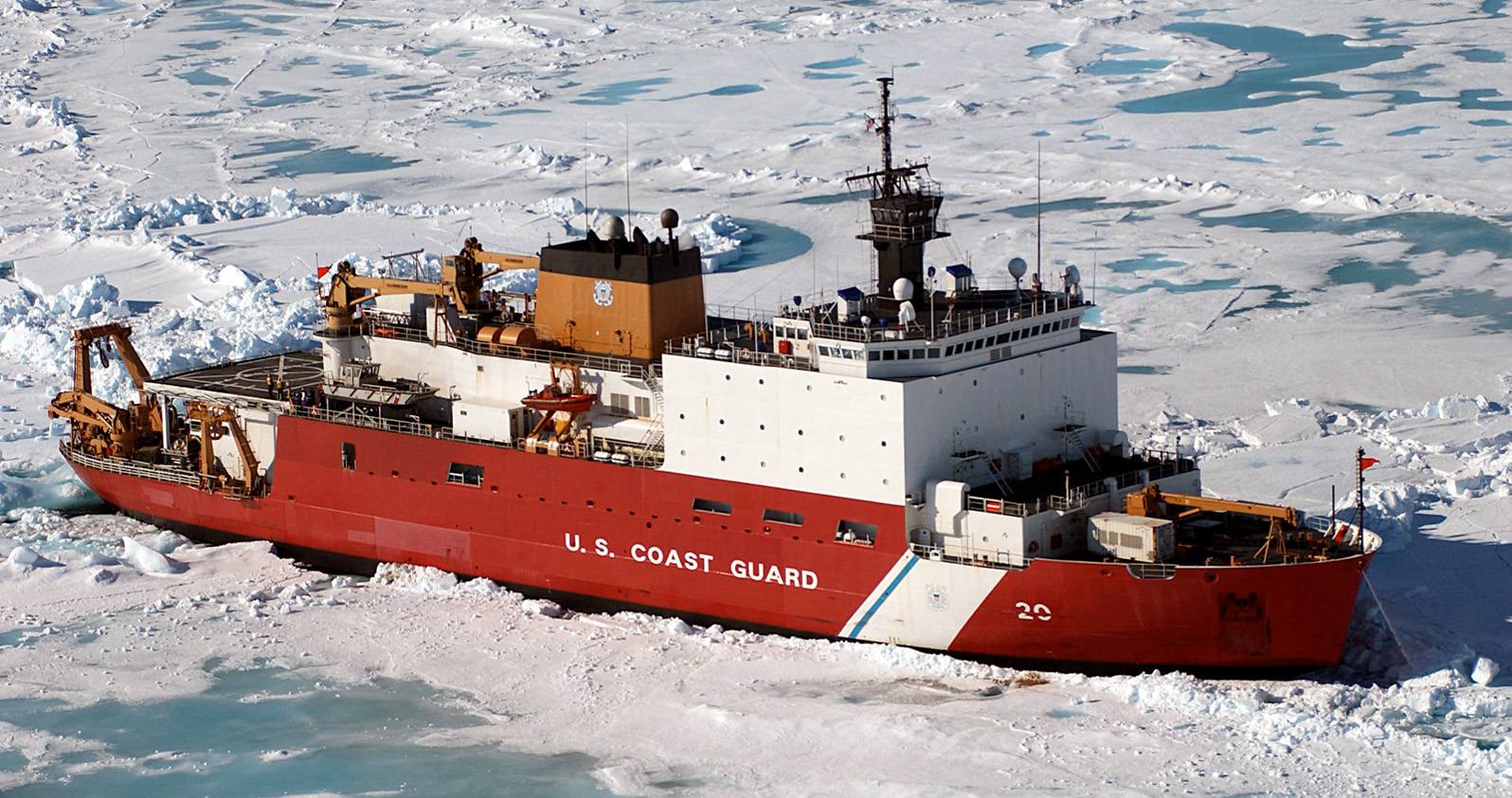
Now China is producing its own icebreakers and Russia and China together have far more icebreakers in the Arctic than NATO. The US currently has only one operational icebreaker, while Russia has 40.
Currently Reading
I finished Ed McBain's The Pusher and The Con Man.
Right now I'm reading The Fellowship of the Ring by J.R.R. Tolkien. I've only read his books in Swedish before and it's great to read in the original language!