A Novel Gets Withdrawn Because of AI
Welcome to the April issue of Hacker Chronicles!
I was going to share my recent research trip to Hong Kong with photos and cyberpunk nerdiness. I even have that newsletter issue drafted. But then an AI publishing scandal erupted and I felt I should comment on it. Once that was done I had already written a bunch! 😅
So I hope you're OK with an AI scandal for April and I'll get you the Hong Kong trip in May. I dislike not delivering on expectations, but if I send you an absolutely huge issue I doubt you'll read it all.
Enjoy!
/John
Writing Update
March featured much more writing time than February. No flu and no road trip with the family. I went to the Sunday writers meetup one weekend and had a great chat about Gibson and sci-fi.
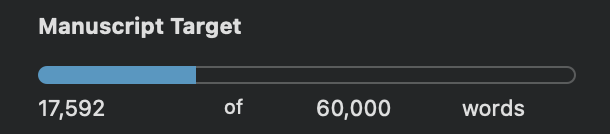
I've started writing a whole new segment of the novel I'm working on. That's where the majority of the 3,000+ words in March have landed. As you know, I'm writing out of order for the first time. It'll be interesting to see what my conclusions are about that when I'm done. I suspect that it's one of those things where your perspective develops slowly. You have some initial reactions but they fade away if you stick with it.
Here's where my next novel stands:
April Feature: A Published Novel Gets Withdrawn Because of AI
You may have read the AI scandal that recently shook the publishing and author worlds. I have thoughts.
The Scandal and Allegations
Hachette Book Group withdrew the horror novel Shy Girl after allegations that its author Mia Ballard had relied heavily on artificial intelligence to write the book.
Shy Girl was traditionally published in the UK in November last year and was supposed to go live in the US when they pulled it.

Around new year, a self-described book editor posted on Reddit "Shy Girl by Mia Ballard. Does anyone else think this was written by ChatGPT?".
A month later, the book influencer Frankie posted a 2 h 40 min YouTube video analyzing the whole book in its original self-published form. I've not watched the whole video but it has 1.4 million views. Frankie is dismayed by the poor quality of the writing.
The author allegedly commented on the YouTube video. That comment may have been deleted but a screenshot still exists:
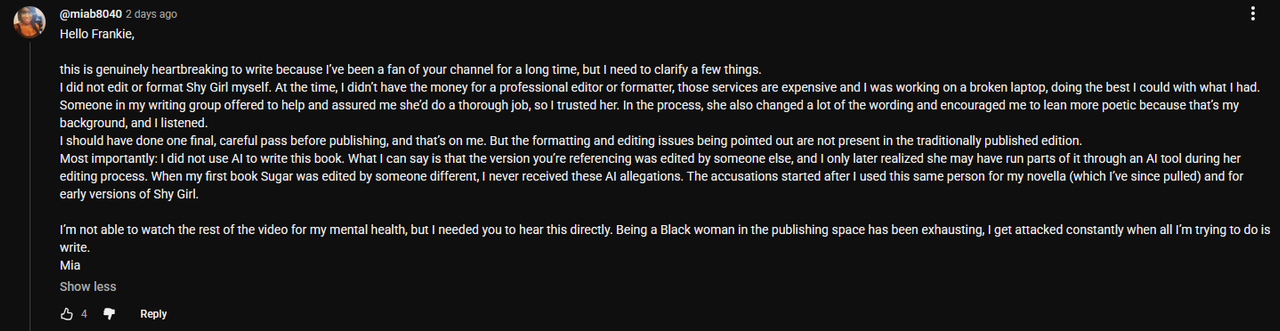
Ballard, if it is her, explains how she wrote Shy Girl as an indie author with no means to pay for professional editing. She instead got help from her writing group and didn't review the editing before self-publishing. Later, Hachette Book Group contracted the book, did its own editing, and re-published. A key comment from Mia Ballard is this:
Most importantly: I did not use AI to write this book. What I can say is that the version you're referencing was edited by someone else, and I only later realized she may have run parts of it through an AI tool during her editing process.
The New York Times ran its own analysis and broke the story to the mainstream (paywalled article). The newspaper said they contacted Hachette about the concerns the day before the publisher announced its cancellation of Shy Girl in the US.
Reactions After the Book Was Pulled
Naturally, there has been a ton of commentary and reactions to this. The questions I've seen raised over and over are:
- Can we even reliably detect AI writing? Or was this just a bad enough case while most secret AI writing goes unnoticed?
- Did the publisher do their job here? Or are they cynically publishing just for the money? Maybe they used AI too!
- This casts a shadow on all authors, especially indie authors.
The author and critic Emily C. Hughes was interviewed by Slate regarding the scandal and said:
When a publisher picks up a previously self-published book to bring it to a wider audience, the amount of editing that happens between the self-published version and the traditionally published version is minimal. It's maybe a copy edit. And the logic there is, Well, people already like this, so we don't have to mess with it too much.
The Slate article goes on saying:
But it runs deeper than that, and people I spoke to said they expected that we will see A.I. usage creep into printed books across the industry. Books in which ideas or plot, rather than the quality of the writing itself, are the key sells will probably be affected the most by A.I. creep.
… and …
A.I. detection software, while improving, has been shown to be fallible at best, often falsely labeling text produced by writers who are non-native English speakers as A.I.-generated.
My Thoughts
I wrote extensively about my deliberate approach to generative AI, as an author, in my January 2025 newsletter issue. Originality, authenticity, and creativity are dear to me. I don't write to produce as many novels as possible. The writing needs to be mine. But generative AI is great for research, copy editing, and even creative challenges.
Now, regarding what went down with Ballard's Shy Girl …
In her alleged YouTube comment, she said she handed over editing to a person in her writing group. That already sounds a bit weird to me. My developmental editors tell me what they think I should change. They don't change things for me. And my copy editor sends me all her proposed changes as tracked changes in a Word doc. I have to approve or reject every single one of them.
But OK, she handed over editing to a friend. To then not even read your manuscript post editing? And publish under your own name?
Nah, I'm going with Occam's Razor here, paraphrased as "of two competing theories, the simpler explanation of an entity is to be preferred." I don't think this was some writing group friend who went rogue on Ballard and secretly transformed her novel into a largely AI-generated one. The simpler explanation? Ballard had a good creative idea for a horror story and used generative AI to write it.
The only two things that can build and maintain trust between authors and readers today are:
- Some kind of chain of trust where Person A knows the author personally and vouches for them, then Person B knows Person A and vouches for them, and so on. Yes, Person A can be in on the scam and lie, but chain of trust is how we humans deal with what to believe.
- A direct relationship with readers where the author shares their writing journey and builds trust along the way. I do that with this newsletter! Sure, I could be lying and generating my books with AI. But you know I published my first novel well before the ChatGPT revolution, and I offer you writing details to build trust.
Authenticity is part of the reading experience. It's perfectly OK to love a book written by AI. But you deserve to know that it was written by AI.
Currently Reading
I finished The Fellowship of the Ring by J.R.R. Tolkien. A pure joy! I'm already looking forward to the next book in the trilogy but will hold off for a bit.
Right now I'm reading Ed McBain's Killer's Choice. It's the 5th novel in the 87th Precinct series.